The Worshipper
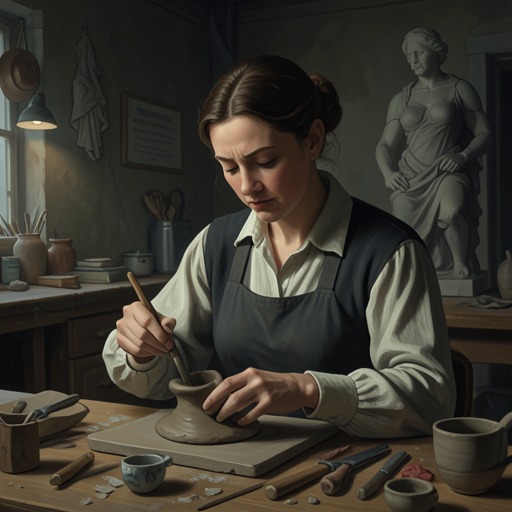
The HollowThe Worshipper is a pearwood figure carved by Henrietta Savernake for the International Group. Its decisive significance lies in the way it turns an abstract artistic idea—submission before an unseen power—into a visible figure that seems to anticipate the emotional truth of Gerda Christow’s marriage to John Christow. The sculpture begins as a carefully judged work of art, but its blank devotion gradually becomes a disturbing image of worship betrayed: a form first understood aesthetically, then recognized as a terrifying likeness of Gerda’s inner condition.
Form, Material, and Intended Meaning
Henrietta Savernake encounters The Worshipper in her studio and examines it with the exacting attention of its maker. The pearwood is a “lovely bit,” with its grain running exactly as she had hoped; she had saved the material for a long time, hoarding it for a work worthy of the wood. She judges the result to be the best thing she has produced in a considerable period and considers it an appropriate exhibit for the International Group.
The figure’s meaning is concentrated in its body rather than in any individualized face. Henrietta has captured humility through the strong muscles of the neck, the bowed shoulders, and the slightly raised head. The face is deliberately featureless because worship, in her conception, drives personality out of the worshipper. The sculpture therefore represents more than ordinary reverence: it embodies submission, adoration, and a final devotion that passes beyond reverence into idolatry. Its body is strong, but its strength is placed entirely at the service of surrender.
John Christow’s Reaction
John Christow first sees the figure when his conversation with Henrietta is interrupted by the sight of a wooden form about five feet high. Learning that it is made of pearwood and intended for the International Group, he focuses immediately on the neck and shoulders. He recognizes the heavy forward slant and the bowed posture as the work’s central achievement, calling the submission expressed by those forms wonderful.
His admiration is inseparable from his anger. John believes Henrietta has been using Gerda Christow as the concealed subject of the sculpture and orders her to leave Gerda alone. Henrietta answers that Gerda would not recognize herself and that no one else would either, insisting that the figure is not Gerda and not any particular person. John’s objection nevertheless exposes the danger of the work: although it is formally anonymous, its physical language can be read as a portrait of a specific kind of devotion.
For a moment, John’s resentment gives way to absorbed attention. The figure offers worship to an unseen deity; its face is raised, blind, dumb, devoted, and at once terribly strong and fanatical. This combination changes his response from irritation to reluctant recognition. He calls the sculpture terrifying, not because it depicts a conventional monster, but because its disciplined beauty reveals how powerful and dangerous absolute devotion can become.
The Sculpture as Foreshadowing
Henrietta’s own interpretation of The Worshipper makes it a visual counterpart to Gerda’s emotional life. She has not carved an identifiable likeness, but she has given physical shape to the condition of surrender that she senses in Gerda. When Henrietta tells John that the figure might be looking at him, the sculpture’s direction of attention becomes charged with dramatic meaning. Its unseen object of worship can be understood as John himself, while its blank face leaves the worshipper without an independent identity.
The work thus foreshadows the later revelation of Gerda’s attitude toward John. Gerda eventually states that she trusted him and believed in him as though he were God, imagining him to be the noblest and finest man in the world. Her language confirms the sculpture’s original vocabulary of worship, but it also supplies the reversal that the carved figure cannot show by itself: the idealized god is exposed as a lie, and the worshipper is left with nothing.
From Devotion to Disillusionment
The Worshipper returns to view when Midge Hardcastle sees it in Henrietta’s studio and finds it frightening. Henrietta identifies it again as the work destined for the International Group, but Midge’s response emphasizes that the sculpture has escaped the safe category of an exhibit. Its effect is not merely decorative or contemplative; it produces fear because its posture suggests a devotion so complete that the worshipper’s self has disappeared.
After John’s death, Gerda’s confession gives the figure its most disturbing interpretation. She explains that she had worshipped John and, after discovering that her faith in him was founded on a lie, could bear the result no longer. Henrietta watches her with fascination because Gerda has become the living realization of the form she carved: blind devotion thrown back upon itself, disillusioned and dangerous. The sculpture’s significance therefore changes retrospectively. What first appeared to be an impersonal study of religious submission becomes an image of Gerda’s emotional structure and of the violent consequences of making another human being into an absolute object of faith.
Narrative and Thematic Significance
The Worshipper operates as an object that crosses the boundary between art and evidence. Henrietta insists on its artistic impersonality, while John recognizes the psychological accusation embedded in its posture. Neither reading fully cancels the other. The figure is not literally a portrait of Gerda, yet its formal qualities provide a language through which Gerda can later be understood more clearly than through her earlier amiability or silence.
Its featureless face is especially important. By removing individual personality, Henrietta makes the figure universal, but that universality also creates vulnerability: anyone whose identity has been surrendered to an idol may inhabit it. When Gerda’s faith collapses, the absence of a face becomes an image of the self that has been emptied by worship. The Worshipper is consequently both an accomplished sculpture and a grim interpretive key to the tragedy surrounding John Christow—a beautiful embodiment of devotion whose hidden subject is not a person’s features, but the peril of devotion without limits.